
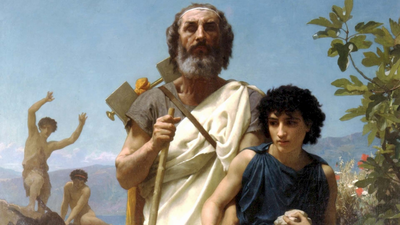
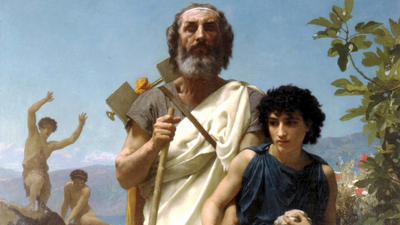
A lone hiker caught in a sudden mountain blizzard could freeze within hours without shelter, while a field mouse survives by tunnelling beneath the snow. A newborn horse can stand and run within minutes of birth, while a human baby depends on others for years.Among all living creatures, humans often see themselves as the dominant species. Yet without our tools, technology, and social systems, we are surprisingly fragile.This idea is captured in line 130 of Book 18 of Homer’s Odyssey: “Of all creatures that breathe and move upon the earth, nothing is bred that is weaker than man.”Translated from ancient Greek, the line is not about hopelessness. Instead, it reflects how uncertain human life is. Homer argues that when life is going well, people often believe their good fortune will last forever. But when hardship comes, many struggle to cope with how quickly circumstances can change.
A disguised king warns a doomed suitor
These lines appear late in The Odyssey, which was written around the 8th century BCE. After spending 20 years away fighting in the Trojan War and trying to return home, Odysseus finally reaches Ithaka disguised as a poor beggar named Aethon.His palace has been taken over by more than a hundred suitors who want to marry his wife, Penelope, while wasting his wealth. Among them is Amphinomus, one of the few who behaves with kindness and respect. After giving the disguised Odysseus some bread and wishing him well, Amphinomus receives an unexpected warning.Drawing on his own life as a king who once enjoyed power, wealth, and military success before losing everything through shipwreck and the will of the gods, Odysseus reminds him that human fortune never stays the same.“Of all creatures that breathe and move upon the earth, nothing is bred that is weaker than man. For he thinks that he will never suffer evil in time to come, so long as the gods grant him prosperity and his knees are quick; but when the blessed gods weave sorrow for him, this too he bears perforce with a patient heart.”Odysseus tells Amphinomus to leave the palace before its true master returns. Amphinomus is unsettled by the warning but chooses to stay. In the story, the goddess Athena has already decided his fate.
The idea of ephemeros
In ancient Greek literature, human weakness is not mainly about physical strength. Instead, it is about how uncertain and temporary human life is. The Greeks used the word ephemeroi, meaning “creatures of a day,” to describe mortals.Unlike the immortal gods, whose power never fades, human lives can change completely in a very short time. Good fortune, health, wealth, and happiness can all disappear unexpectedly.The philosopher Friedrich Nietzsche later praised this view of life, arguing that the ancient Greeks became strong not by ignoring human weakness but by accepting it honestly.Later philosophical traditions developed similar ideas.
- Stoicism: Thinkers such as Epictetus and Marcus Aurelius argued that because we cannot control external events, wisdom comes from focusing only on what lies within our control.
- Existentialism: Jean-Paul Sartre believed human anxiety comes from knowing that health, security, and stability can disappear without warning.
Animals respond mainly to what is happening around them. Humans face not only physical dangers but also the emotional burden of worrying about the future or wrongly believing that today’s success will last forever.
Why the idea still matters today
Homer’s message about human fragility still feels relevant in 2026, even in a world shaped by advanced technology.Take global financial markets as an example. In early August 2024, Japan’s Nikkei 225 suffered its biggest one-day fall since 1987, dropping 12.4% after changes in currency carry trades and interest-rate expectations. Automated trading systems accelerated the decline, showing how technology designed to improve markets can also increase instability.The same pattern appears in business and sport.
- Corporate leadership: Technology companies worth billions of dollars can lose value rapidly when economic conditions change, reminding leaders that fast success does not remove financial risk.
- Professional sports: Elite athletes can suffer career-ending injuries in a single moment, turning years of peak performance into a long recovery almost overnight.
Recognising human weakness is not about giving up or expecting failure. Instead, it encourages better planning, stronger institutions, careful risk management, and humility.As Odysseus warned Amphinomus before the final battle began, no amount of success or power guarantees that fortune will always remain on your side.
More than a warning about weakness
Odysseus’ speech to Amphinomus is often remembered for its reflection on human weakness, but in the context of The Odyssey, it also serves as a warning against hubris…the Greek idea of excessive pride or overconfidence. The suitors believe Odysseus is either dead or too weak to challenge them. Their confidence comes not from wisdom but from the mistaken belief that their good fortune will continue indefinitely.Amphinomus is different from the other suitors. Throughout the poem, Homer presents him as more thoughtful and compassionate than figures such as Antinous or Eurymachus. Odysseus even pulls him aside and quietly urges him to leave the palace before violence begins. It is one of the few moments in the epic where an enemy is given a genuine chance to escape. Yet Amphinomus ignores the warning and returns to his place among the suitors. Homer later explains that Athena had already marked him for death, making the scene a powerful example of the tension between human choice and fate.