Most people measure their relationship with a country, a company or a team by what it gives them back. John F. Kennedy asked an entire nation to flip that measurement around. “Ask not what your country can do for you, ask what you can do for your country,” he said in his 1961 inaugural address, turning citizenship from something received into something owed. It became the single most repeated line of his presidency, quoted so often that its exact wording is more familiar to most people today than almost anything else he said in office. The idea itself was not new. Versions of the same sentiment had circulated in speeches and sermons for years before Kennedy ever stood at the podium. What made this version different was how tightly it was built, a mirror-image sentence, brief enough to remember after hearing it only once.
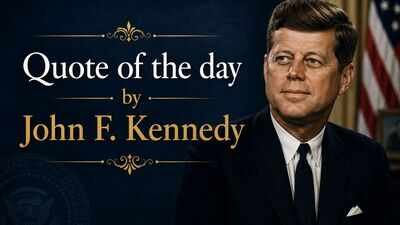
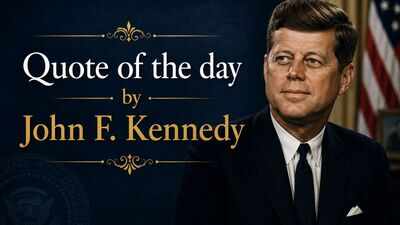
Quote of the day by John F. Kennedy
“My fellow Americans, ask not what your country can do for you—ask what you can do for your country.”
Understand the meaning of the quote by John F. Kennedy
The line inverts a relationship most people take for granted without examining closely. Citizens typically think of their country primarily as a provider, of services, protections and opportunities delivered to them. Kennedy’s sentence asks each listener to flip that assumption around, treating citizenship as something owed by the individual to the collective, rather than the other way round.This was not an abstract philosophical point for its own sake. Kennedy delivered it at the height of the Cold War, addressing a generation he described elsewhere in the same speech as tempered by war and disciplined by a hard, uncertain peace. The request for contribution rather than entitlement was aimed squarely at that generation, asking them to see their own effort as part of what kept the country’s promise intact, not simply something they were entitled to receive from it.It is worth being precise about what the line is not saying. It is not arguing that a country owes its citizens nothing, or that public services and protections do not matter. It is arguing that the relationship only holds up if effort flows in both directions. A country that gives everything and asks nothing back tends to hollow out over time, just as a citizen who takes everything and contributes nothing eventually undermines the thing they depend on.
The two halves of the sentence, and why the order matters
Look closely at the structure and the quote is really two nearly identical sentences placed back to back, with only the subject and object swapped. “What your country can do for you” becomes “what you can do for your country,” the same handful of words rearranged into a mirror image of themselves.That symmetry is not decoration. It forces the listener to sit with both halves of the relationship at once, rather than only the half that usually gets attention. Most appeals for civic duty simply add a request for contribution on top of an existing sense of entitlement. Kennedy’s version does something sharper. By putting the two halves in identical language, it makes the imbalance between them impossible to miss, and that is very likely why the sentence has survived so much longer than the rest of the speech surrounding it.Compare it with a more ordinary version of the same appeal, something like “your country has given you a great deal, so please consider giving something back.” The sentiment is identical. The impact is not. The ordinary version treats contribution as an optional afterthought tacked onto a relationship that is otherwise settled. Kennedy’s version treats the two directions of the relationship as equally weighted from the start, which is a considerably harder claim to shrug off.
From words to action: The Peace Corps
Kennedy did not leave the idea as a standalone line. Within two months of the inauguration, he established the Peace Corps by executive order, inviting young Americans to serve abroad in education, agriculture and public health rather than simply enjoying the comforts of home. The programme gave the quote an immediate, practical outlet, turning an abstract appeal into an actual government initiative that tens of thousands of volunteers eventually joined.That link between the words and the policy is a large part of why the phrase has outlasted so many other pieces of political oratory from the same era. It was not left as a rhetorical flourish with nothing behind it. It became a specific, testable expectation, one that asked citizens to measure their own contribution to public life rather than only their consumption of it. The Peace Corps still operates today, more than sixty years later, built on the same basic premise that individual effort, not government policy alone, shapes a country’s standing in the world.
Why the default question is almost always “what do I get”
Kennedy’s line works partly because it goes against a very ordinary human instinct. Left unprompted, most people evaluate a group, a job or a country largely by what it offers them, and rarely pause to weigh their own side of that exchange with the same attention. This is not usually selfishness in any deliberate sense. It is simply easier to notice benefits received than effort given, since one shows up as a clear, countable gain and the other does not.The quote’s usefulness comes from forcing that imbalance into view. Once a person actually asks what they have contributed to a group they belong to, rather than only what it has given them, the answer is often thinner than expected. That gap, between the benefits people can list easily and the contributions they can list just as easily, is exactly what the sentence was designed to expose.This is also why the line still gets quoted so far outside its original political context. Managers use versions of it to talk about company culture. Coaches use it with teams that expect results without matching effort. Parents use a softer version of it with children who treat a household’s comforts as automatic rather than maintained. The setting changes constantly. The underlying imbalance the quote is naming does not.
How to apply this quote in daily life
You do not need a national stage to apply the logic behind this line. Most communities, workplaces and families run on some version of the same imbalance Kennedy was addressing, a tendency to notice what a group provides to you long before noticing what you provide back to it.A practical version of the exercise is to pick one setting where you regularly benefit, a neighbourhood, a team, a family, and ask honestly what you have contributed to it recently, separate from what it has given you. The answer is not always comfortable. That discomfort is close to the actual point Kennedy was making. Contribution, unlike benefit, requires a deliberate choice, and it rarely happens automatically.
Other famous quotes by John F. Kennedy
- “We choose to go to the moon in this decade and do the other things, not because they are easy, but because they are hard.”
- “A man may die, nations may rise and fall, but an idea lives on.”
- “Change is the law of life. And those who look only to the past or present are certain to miss the future.”
- “Forgive your enemies, but never forget their names.”