
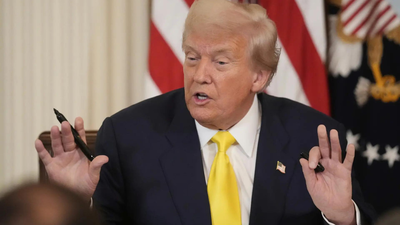
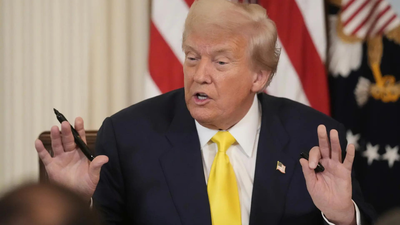
TOI correspondent from Washington: In a striking public rebuke to Tel Aviv, US President Donald Trump on Sunday urged restraint after an Israeli strike on Beirut threatened to derail what he has repeatedly described as an imminent peace agreement with Iran, a deal that despite his confident predictions would be signed on Sunday, had not materialized till the time of going to press. “This morning’s attack on Beirut should not have happened,” Trump declared on Truth Social. “We are very close to a Deal that will bring peace to the region, including to Lebanon… This could be the beginning of a long and beautiful peace… Let’s not blow it!” The US President said while Israel has the right to defend itself against threats, the attack it was responding to was” very small and meaningless, nobody was hurt, injured, or killed, and should not disrupt this important process.”The unusually direct message reflected growing White House frustration with Israel’s apparent determination to maintain military pressure on Hezbollah and Iran’s regional allies, even as Washington races to secure a broader understanding with Tehran. Regional analysts believe the Israeli strike on Beirut’s southern suburbs was not merely an operational response to a “meaningless” Hezbollah attack, but a meticulously timed diplomatic middle finger. Tel Aviv is reportedly convinced that Trump — ever eager for a dramatic diplomatic flourish — is offering Iran more concessions than they consider prudent. Among the reported inducements are sanctions relief, release of frozen Iranian assets and a phased reopening of maritime access through the Strait of Hormuz that will revitalize Iran’s economy. The result has been a geopolitical spectacle worthy of reality television: America’s closest Middle East ally appearing to sabotage the signature foreign-policy initiative of a president who prides himself on being the world’s ultimate dealmaker – all in the middle of a cagefight on the lawns of the White House to celebrate his 80th birthday. The peace agreement itself remains tantalizingly close and maddeningly out of reach. Trump had confidently predicted that the accord would be signed on Sunday, but evidently Tehran, has not received that memo. Iranian officials have pushed back against the White House timetable and mocked Trump, while insisting that while negotiations were progressing, several technical and political issues still required review. Iranian Foreign Ministry spokesman Esmaeil Baghaei cautioned against “premature announcements” and emphasized that no final signing date had been agreed upon. Iranian negotiators also cited the Beirut strike as evidence that regional stability guarantees remained uncertain. Tehran’s message was simple: diplomatic agreements and timetables are not produced like Trump’s on-the-fly campaign rally schedules. Vice President JD Vance, meanwhile, remains on standby to fly to Geneva at short notice if negotiations suddenly crystallize into an agreement. It would not be the first time he has been dispatched as Trump’s roving envoy amid concern among his supporters that he’s being thrown into a blender that will do his political future no good. Earlier this year, Trump sent Vance to Pakistan for talks with Iranian negotiators, and he remained on alert for a follow-up visit as negotiations ebbed and flowed. In some MAGA circles, the vice president has acquired a reputation as the administration’s equivalent of a substitute goalkeeper — warming up continuously on the sidelines while awaiting the president’s latest improvisation.The broader atmosphere surrounding the negotiations has done little to reassure America’s allies. Analysts describe Trump’s foreign policy as operating somewhere between strategic ambiguity and freestyle jazz, with harsher critics, channeling Shakespeare, asserting it is full of sound and fury, signifying nothing. Policy announcements emerge through Truth Social posts, deadlines appear and disappear, and military action is threatened in one message and suspended in the next.All this is unfolding as Trump prepares to depart for Europe on Monday for the Group of Seven (G-7) meeting – where he has previously treated allies and partners with pugilistic bombast – after watching a cagefight on the lawns of the White House. The optics have mystified diplomats, many of whom are trained extensively in nuclear deterrence theory but had somehow failed to anticipate conducting Middle East peace analysis against the backdrop of a UFC scrap. For now though, the much-heralded Sunday signing in Switzerland remains a diplomatic mirage while the prospect of blood in the UFC cagefight remains real.